What Benefits Does Go Bring? A Thorough Guide to Its Brain Training and Educational Effects
Go (the board game) offers wide-ranging benefits across all ages, including improved concentration, memory, logical thinking, social connection, stress relief, and potential support for brain health.
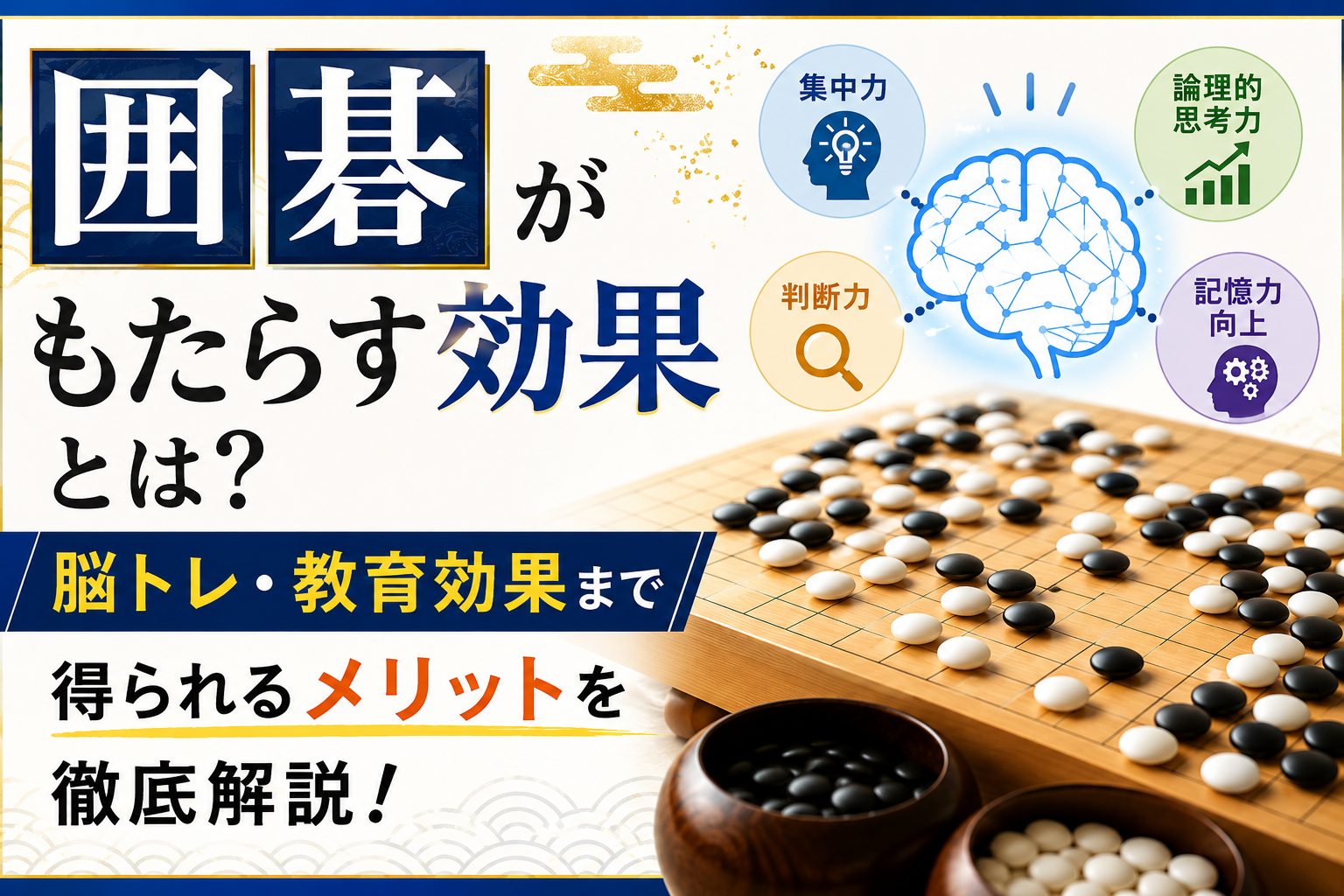
Go is often seen as “too difficult” or “something older people play.”
However, in reality it’s a game that people of all ages—from children to working adults and seniors—can enjoy, and it offers many effects and benefits.
Brain training, educational benefits, dementia prevention, broader social connections—Go brings many positive effects to everyday life.
In this article, we’ll clearly explain the effects and benefits of Go you’ll want to know, organized by age group.
[toc]
Main Benefits of Go (Overview)
The main benefits you can gain by starting Go include the following:
・Improves concentration and attention
・Enhances memory and spatial awareness
・Develops logical thinking and reading ahead
・Builds character traits such as manners and patience
・Expands your social circle and creates new connections
・May help prevent dementia and stimulate the brain
・Becomes a source of purpose and a hobby you can enjoy for a long time
One of Go’s greatest appeals is that it offers benefits suited to your age and goals.
Go as Brain Training
Go is widely known as a “thinking game.”
Its nature—reading the whole board each move and making decisions while predicting several moves ahead—provides stimulation to various brain functions.
A unique strength of Go is that it uses multiple cognitive functions at once, such as concentration, memory, and logical thinking.
Improves Concentration and Attention
In Go, you need to keep your mind on the board throughout the game.
Continuously thinking through your own plan while reading your opponent’s intentions naturally trains deep concentration.
Because a single mistake can affect the entire board, maintaining attention is also essential.
This “habit of focusing” gradually takes root as you play more games.
For children, it can lead to better focus in studying; for adults, it can improve attentiveness at work.
By enjoying Go regularly, your “ability to keep thinking” is naturally refined.
Enhances Memory and Spatial Awareness
A Go board is 19×19 lines—361 points in total.
During a game, you must grasp the placement of stones across the whole board while using memory of past sequences and joseki.
This repetition is thought to help maintain and improve memory.
Also, the nature of viewing the board from above while keeping multiple areas in mind at once serves as training for spatial awareness.
Few activities use both memory and spatial recognition together, making this a distinctive brain-training effect of Go.
Develops Logical Thinking and Reading Ahead
In Go, you play not only for “the next move,” but with several moves—or even dozens of moves—ahead in mind.
Thinking through the best response to your opponent and then reading the continuation beyond that is logical thinking itself.
A natural cycle of “hypothesis → verification” happens in every game.
Once you develop the habit of reading ahead, your ability to anticipate situations in everyday decisions and problem-solving also improves.
A habit of thinking logically rather than emotionally is gradually cultivated by continuing Go.
Educational Benefits for Children
Go is also gaining attention as a tool for children’s intellectual and emotional development.
In the process of learning the rules and playing games, children naturally develop not only academic ability but also foundational life skills such as manners, patience, and self-management.
It also pairs well with studying and other lessons, supporting children’s growth from multiple angles.
Builds Manners and Patience
Go has etiquette and mental rules such as “greet before and after the game” and “don’t take back a move after playing it.”
By respecting the opponent and staying focused through to the end, children naturally learn the importance of manners and develop patience.
Also, the experience of accepting a loss and moving on to the next game fosters emotional control.
Developing the attitude of “staying calm even when frustrated” is a major reason Go is valued in educational settings.
Connection to Academic Improvement (Math, Logic, etc.)
The relationship between Go and academic improvement is also drawing attention in education.
Spatial awareness for grasping shapes on the board relates to geometry problems, and thinking that calculates gains and losses of stones connects to arithmetic and mathematics.
The sense of balance between seeing the whole and focusing on local areas also helps with reading and understanding logical texts.
Some elementary schools have introduced Go classes, and there are reports of results such as improved concentration and logical thinking.
Go’s educational value lies in sharpening skills that connect to learning while still feeling fun as a game.
A Habit of Focused Thinking Helps with Studying
In Go, if you lose focus mid-game, you lose track of the flow of the position.
The habit of “thinking it through to the end” naturally develops as you play more games.
This habit also becomes a major strength in studying.
The attitude of not giving up halfway when solving problems and thinking persistently to the end is exactly the “think-through power” trained by Go.
Because Go can improve concentration while staying enjoyable, it’s an effective way to build children’s study habits.
Benefits of Starting Go as a Working Adult
Even for busy working adults juggling work and childcare, Go is a hobby that brings richness to life.
It offers intellectual stimulation, stress relief, and new connections with people—benefits that make everyday life more fulfilling.
Another appeal for adults is that you can enjoy it no matter what age you start.
Expands Your Social Circle
Go has a culture where people can enjoy the game as equals regardless of age, occupation, or background.
At local Go salons or community-center Go circles, you can meet and connect with people you wouldn’t normally encounter in daily life.
A key feature of Go is how naturally people with a shared hobby can open up to each other.
Whether locally or online, new connections are born through Go.
Stress Relief and a Change of Pace
While you’re focused on Go, you can temporarily forget work worries and everyday stress.
Go, where you let your thoughts roam within the limited space of the board, can be described as “a walk inside your head.”
After the game ends, you feel a sense of accomplishment and fulfillment, leading to mental refreshment.
Many people find that the habit of “playing one game after work” naturally becomes a stress-relief routine.
Being able to enjoy it with deep focus even in a short time is one reason Go is supported by busy adults.
Trains Thinking Skills Useful for Work
The “reading ahead,” “big-picture perspective,” and “calm judgment” cultivated in Go are skills that also help in business.
The ability to anticipate risks by reading ahead in a project, and the ability to make logical decisions without being swayed by emotion, are trained day to day through play.
The sense of balance between seeing the whole board and choosing local moves connects to the mindset of “seeing both the trees and the forest.”
Being able to improve work-relevant thinking skills while enjoying it as a hobby is why Go is recommended for adults as well.
Effects of Go for Seniors
For seniors, Go is one of the best hobby options to support brain health and a fulfilling retirement.
Being able to gain both intellectual stimulation and human connection at the same time is a major reason Go is popular among seniors.
Dementia Prevention and Brain Activation
Go is a game that uses concentration, memory, judgment, and spatial awareness in combination during play.
By engaging multiple cognitive functions at once, it provides continuous stimulation to the brain as a whole.
For older adults, continuing to actively use the brain is expected to help slow cognitive decline.
The proactive attitude of “keep thinking in order to win” activates the brain in a way that differs from puzzles or reading.
Because you can keep improving even as you age, Go is a hobby that can continue providing positive stimulation to the brain over the long term.
A Lifelong Hobby and a Source of Purpose
In Go, there is no “end point” to improvement.
Beginners can enjoy it, yet even after playing for many years, new discoveries and challenges keep appearing.
A desire to “get stronger” naturally arises and can become a source of purpose.
The fact that you can enjoy it as long as you can think, even if physical strength declines, is a major advantage as a senior hobby.
Having “something to devote yourself to” in retirement can bring mental fulfillment and a sense of vitality to daily life.
As an intellectual hobby you can continue for a long time, Go is especially recommended for seniors.
Prevents Isolation Through Connections with Others
Because Go is a two-player game, you always need an opponent.
By joining a Go salon or local circle, you naturally gain friends who share the same hobby.
From the perspective of easing loneliness and maintaining ties with society, Go enriches seniors’ lives.
Through Go, you’ll likely come to enjoy interacting with others even more.
Start Go and Enrich Your Life!
Go offers cross-generational benefits such as brain training, education, stress relief, dementia prevention, and expanded social connections.
From improving children’s concentration and academic skills, to strengthening adults’ thinking skills and relieving stress, to activating seniors’ brains and creating a sense of purpose—Go enriches life in every situation.
If you want to start Go, PlayGo.gg is recommended.
With a simple registration, you can use AI matches, tsumego, and matchmaking features for free, so beginners to advanced players can enjoy it at their own pace.
First, access PlayGo.gg and try Go for yourself.
There’s plenty of content to help you learn Go from zero.
Start Go today and make your life even richer.