Which Country Did Go Originate In? A Clear Guide to Its Chinese Origins and How It Reached Japan
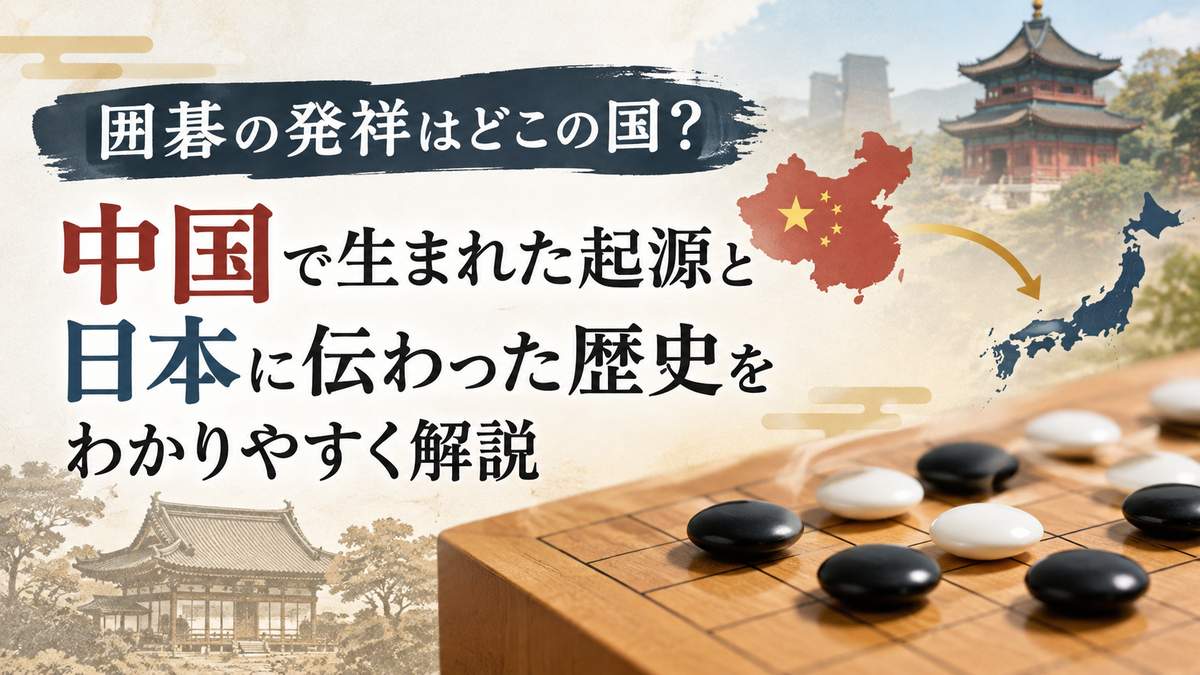
Have you ever wondered, “Which country did Go come from?”
Because it’s strongly associated with Japanese traditional culture, many people assume it originated in Japan.
In fact, Go originated in China.
It is said to have been born roughly 4,000 years ago.
In this article, we整理 the theories surrounding Go’s origins, as well as the truth behind common misconceptions like “it originated in Japan” or “it originated in Korea.”
We’ll also explain when Go reached Japan and how it developed there.
[toc]
Go originated in China, and is said to have been born about 4,000 years ago
Go’s country of origin is China.
According to the Nihon Ki-in, Go is said to have begun in China about 4,000 years ago.
However, there are no reliable records showing exactly who invented it and when.
As for its origins, several stories have been passed down—such as legends that an ancient emperor created it, or theories that it began as a tool for divination.
There are also theories that place its origin in India or Tibet, but the mainstream view is that it originated in China.
Go, born in China, spread to the Korean Peninsula and Japan.
It is thought to have reached Japan from China, and some believe it came via the Korean Peninsula.
In China it is still called “围棋 (Weiqi)” and is enjoyed by many people.
Three theories about the origin of Go
The truth is, we don’t know exactly how Go was born.
For that reason, many different theories—often including legends—have been told since ancient times.
Here are three representative ones.
None is definitive, but they convey how people in antiquity viewed Go.
A legend that Yao and Shun created it to educate a child
The most famous story is that Go was devised by Yao (堯/尭), a legendary emperor of ancient China.
It is said that Yao created Go and taught it in order to raise his son, Dan Zhu, into a wise person.
This legend has a slightly ironic continuation.
In the end, Yao passed the throne not to his son Dan Zhu, but to Shun, whom he chose regardless of lineage.
Perhaps that gifted education through Go didn’t work out so well.
Of course, both Yao and Shun are legendary figures.
Rather than historical fact, take this as a tale that speaks to Go’s age and depth.
A theory that it began as a tool for divination and astronomy
Another theory says the Go board and stones were originally tools used for divination and astronomy.
In this view, the board represents the universe and the stones represent stars, and people used them to read calendars and fortunes.
For example, a 19×19 board has 361 intersections; excluding the single central point leaves 360.
This is close to the number of days in a year; the four corners were likened to the four seasons, and the central “tengen” to the center of the universe.
There is also an interpretation that white stones represent day (yang) and black stones represent night (yin).
If this theory is correct, it means a divination tool later transformed into a two-player game of competing for territory.
There are also India/Tibet origin theories
There are also theories that place Go’s origin outside China. The Nihon Ki-in also notes that “there are theories that it originated in India or Tibet.”
In Tibet, a form of Go called “Miman” survived until around the mid-20th century.
It uses a 17×17 board rather than today’s 19×19, and is thought to preserve an early form of Go that spread from China.
However, no solid evidence has been found that Go originated in India or Tibet.
Today, the view that it originated in China is the most common.
Go in China as seen through records and excavated artifacts
That Go was played in China from ancient times can be confirmed not only through legends, but also through written sources and excavated artifacts.
In particular, excavated Go boards show that board size changed over time.
Go appears in The Analects and Mencius
By the Spring and Autumn and Warring States period (770 BCE–221 BCE), Go spread as a game for honing strategy.
Go also appears in The Analects and Mencius, collections of sayings by thinkers of that era.
In The Analects, Confucius leaves a remark to the effect that “rather than spending the whole day idly, it’s better to play gambling games or Go.”
In Mencius, a master named “Yi Qiu (弈秋)” is mentioned as the best player in the country.
In other words, even over 2,000 years ago, strong players were recognized figures.
Later, in the Northern Song, Wangyou Qingyue Ji (忘憂清楽集), considered the world’s oldest surviving Go book, was compiled.
It also includes game records said to be a match between Sun Ce and Lü Fan of the state of Wu during the Three Kingdoms period.
Boards shifted from 17×17 to 19×19: changes revealed by artifacts
Modern Go is played on a 19×19 board.
However, in ancient China, 17×17 boards were used.
In 2002, fragments of a ceramic Go board were found at Yangling, the mausoleum of Emperor Jing of the Former Han in Shaanxi Province.
It is thought to have been used for play by people guarding the mausoleum rather than by royalty.
This suggests that even in the pre-Common Era period, people who were not of high status played Go.
In the Later Han, a Go board was excavated from a tomb in Wangdu County, Hebei Province.
Together with descriptions in texts from the time, it is thought that boards then were 17×17.
Later, during the Northern and Southern Dynasties, 19×19 boards became widespread.
A 19×19 board has been excavated from the tomb of Zhang Sheng from the Sui period (Anyang, Henan Province).
Boards the same size as today were already established roughly 1,400+ years ago.
Go as a cultivated art: “qin, qi, shu, hua”
In ancient China, Go was considered part of a scholar’s cultivation. This idea is expressed in the phrase “琴棋書画 (qin, qi, shu, hua).”
Qin refers to music, qi to Go, shu to calligraphy, and hua to painting.
These four were seen as accomplishments a gentleman (a refined person) should master, and they were taught to children as well.
Go was not played merely as a win-or-lose pastime.
It was cherished as a way to develop thinking ability and character.
Did Go originate in Japan? In Korea? Answers to common questions
You’ll also often hear people say, “Didn’t Go originate in Japan?” or “I heard it originated in Korea.”
In conclusion, neither Japan nor Korea is the country of origin.
So why do these misconceptions arise? Let’s look at each country’s relationship with Go.
Why Go did not originate in Japan
Go was born in China and is thought to have been transmitted to Japan from China.
It is not a game that originated in Japan.
Even so, it’s easy to assume it’s Japanese in origin because Go developed greatly in Japan.
In the Edo period, the shogunate protected the Go head houses (iemoto), and skill levels rose dramatically.
Even in the modern era, Japanese players and the Nihon Ki-in worked hard to spread Go overseas.
Because of this history, Go became firmly associated with the image of “Japanese traditional culture.”
It didn’t originate in Korea either: Go transmitted to the Korean Peninsula
Korea is also one of the countries to which Go was transmitted from China.
It is believed to have reached the Korean Peninsula by at least the 5th century.
In Samguk Sagi (三国史記), an old Korean historical chronicle, a famous Go-related story is recorded.
King Jangsu of Goguryeo sent a monk skilled at Go, Dorim, to Baekje.
Dorim gained the trust of King Gaero of Baekje, a Go lover, and encouraged large-scale construction projects that weakened the country.
Later, Baekje’s capital, Hanseong, fell to Goguryeo in 475.
In Korea, Go is called “Baduk (바둑).”
Modern Korea is one of the world’s Go powerhouses, alongside China and Japan.
While it is not the country of origin, it is certainly a country where Go thrives.
Why Go is called “Go” in English: it comes from Japanese
In English, Go is called “Go.”
This name comes from the Japanese word “碁 (go).”
Go was introduced to the West mainly through Japan, and early Western players learned from Japanese professionals.
In the 20th century, the Nihon Ki-in supported its spread by publishing English-language magazines and sending players abroad.
Because the internationally known name comes from Japanese, it’s understandable that people might mistakenly think Go originated in Japan.
When did Go reach Japan?
The exact time Go reached Japan is actually unknown.
Even so, old records and cultural artifacts suggest that Go took root in Japan at a fairly early stage.
Let’s look at three perspectives that provide clues about its transmission.
A record in the “Wa” section of the Book of Sui
One of the oldest records describing Go in Japan is the “Wa” section in the Chinese historical text Book of Sui (隋書).
Completed in the 7th century, it says of the Japanese people (Wa people) at the time: “They like the games of qi bo, shuoshuo, and chupú.”
The “qi (棋)” here is thought to refer to Go.
The Book of Sui describes a period before the missions to Tang China (Kentōshi) were dispatched.
That is, it’s reasonable to think Go was played in Japan even before the era of the Kentōshi.
Go also appears in the Taihō Code (大宝律令) established in 701.
In the “Sōniryō” (僧尼令), which set rules for monks and nuns, sugoroku and gambling were prohibited, but Go was not.
Go must already have been familiar enough to be mentioned in law.
The legend that Kibi no Makibi brought it, and a “birthplace of Go”
When it comes to Go in Japan, the name Kibi no Makibi is often mentioned.
He was a scholar who traveled to Tang China as an envoy in the Nara period, and a well-known legend says he brought Go back to Japan.
Kibi no Makibi is sometimes called “the founder of Go in Japan,” and Mabi-chō in Kurashiki City, Okayama Prefecture—said to be his birthplace—is known as a Go town.
Since 2011, a national elementary school tournament, the “Kurashiki Kibi no Makibi Cup Children’s Kisei Championship,” has been held.
For those looking for the “birthplace of Go in Japan,” Mabi-chō can be considered a place with deep connections.
However, considering the records in the Book of Sui and the Taihō Code mentioned earlier, Go likely arrived before Kibi no Makibi.
It’s best to enjoy the Kibi no Makibi story as a legend about a figure associated with the development of Go in Japan.
Go boards and stones preserved in the Shōsōin
Evidence that Go was widely played in the Nara period also remains in the Shōsōin in Nara.
The Shōsōin houses three Go boards and Go stones.
Among them, the most famous is the “Mokuga Shitan no Kikkyoku (木画紫檀棊局).”
Made of rosewood (shitan) and decorated using a technique called “mokuga,” which combines woods of different colors, it is a beautiful Go board.
These items have been handed down as treasures associated with Emperor Shōmu.
They show that Go was present even in the emperor’s immediate surroundings.
The history of Go’s development in Japan
After reaching Japan, Go spread from aristocrats to warriors, monks, and commoners.
In the Edo period, skill was refined under a uniquely Japanese system, and Japan became one of Go’s centers.
Let’s look at this progression by era.
Heian period: an aristocratic pastime, appearing in The Tale of Genji and The Pillow Book
In the Heian period, Go spread at court as a game for the aristocracy.
Scenes of Go are depicted repeatedly in literary works of the time.
In Murasaki Shikibu’s The Tale of Genji, there is a scene where Hikaru Genji peeks at women playing Go.
Go also appears in Sei Shōnagon’s The Pillow Book, suggesting how Go blended into the daily life of court society.
An anecdote about Emperor Daigo and the monk Kanren, known as a skilled player, is also famous.
It is said that the emperor played Kanren with a gold pillow at stake.
Kamakura–Muromachi periods: spreading to warriors, monks, and commoners
In the Kamakura and Muromachi periods, Go was no longer only for aristocrats.
Players spread to warriors and monks, and even to farmers and merchants.
In the early Kamakura period, one of Japan’s oldest Go rulebooks, Igo-shiki (囲碁式), was compiled.
Yoshida Kenkō’s Essays in Idleness (徒然草) also includes several Go-related stories.
As it came to be enjoyed regardless of social class, Go took root as part of Japanese culture.
Edo period: the iemoto system and Honinbo usher in a golden age
The Edo period was Go’s golden age in Japan.
Warlords including Tokugawa Ieyasu liked Go, and the shogunate protected it generously.
Central to this was Honinbō Sansa, a monk of Jakkō-ji Temple in Kyoto.
Sansa was the first head of the Honinbō house and is also said to have been the first “Godokoro,” the official in charge of Go under the shogunate (there are various theories about when the Godokoro became an established institution).
After Sansa’s death, an iemoto system formed around four houses—Honinbō, Inoue, Yasui, and Hayashi—and continued until the end of the Edo period.
In exchange for receiving stipends from the shogunate, the iemoto played a game before the shogun at Edo Castle every year on November 17.
This event was called “Oshirogo” (Castle Games).
Because the iemoto competed fiercely for prestige, Go technique advanced greatly.
Modern to present: the founding of the Nihon Ki-in and Go’s global spread
After the Meiji Restoration, the iemoto lost the shogunate’s protection and entered a difficult era.
After a period in which various player organizations formed and split, the Nihon Ki-in was founded in 1924.
In 1939, the Honinbo title match, the “Honinbo Tournament,” began, in which the name Honinbo is contested on merit.
From there, the modern structure of professional title matches took shape.
Today, Go is played all over the world.
In 2016, the Go AI “AlphaGo” defeated top players and became a major topic.
AI-based research has also advanced, and this 4,000-year-old game continues to evolve.
Summary
Go originated in China and is said to have been born about 4,000 years ago.
Legends say Yao created it for his son, and there is also a theory that it began as a tool for divination, but its exact origin is unknown.
The idea that it originated in Japan or Korea is a misconception.
In both countries, Go was transmitted from China, and in Japan it developed to the point that the English name “Go” comes from Japanese.
It is thought to have reached Japan by at least around the 7th century.
Go boards in the Shōsōin and references in Heian literature preserve its presence, and in the Edo period it entered a golden age under the iemoto system.
Despite having such a long history, Go’s rules are simple enough for anyone to learn.
If you’re interested, why not enjoy your very first game casually on PlayGo.gg?