5 Tips for Winning Handicap Games: How to Play 2–9 Stone Games (and How White Should Play Too)
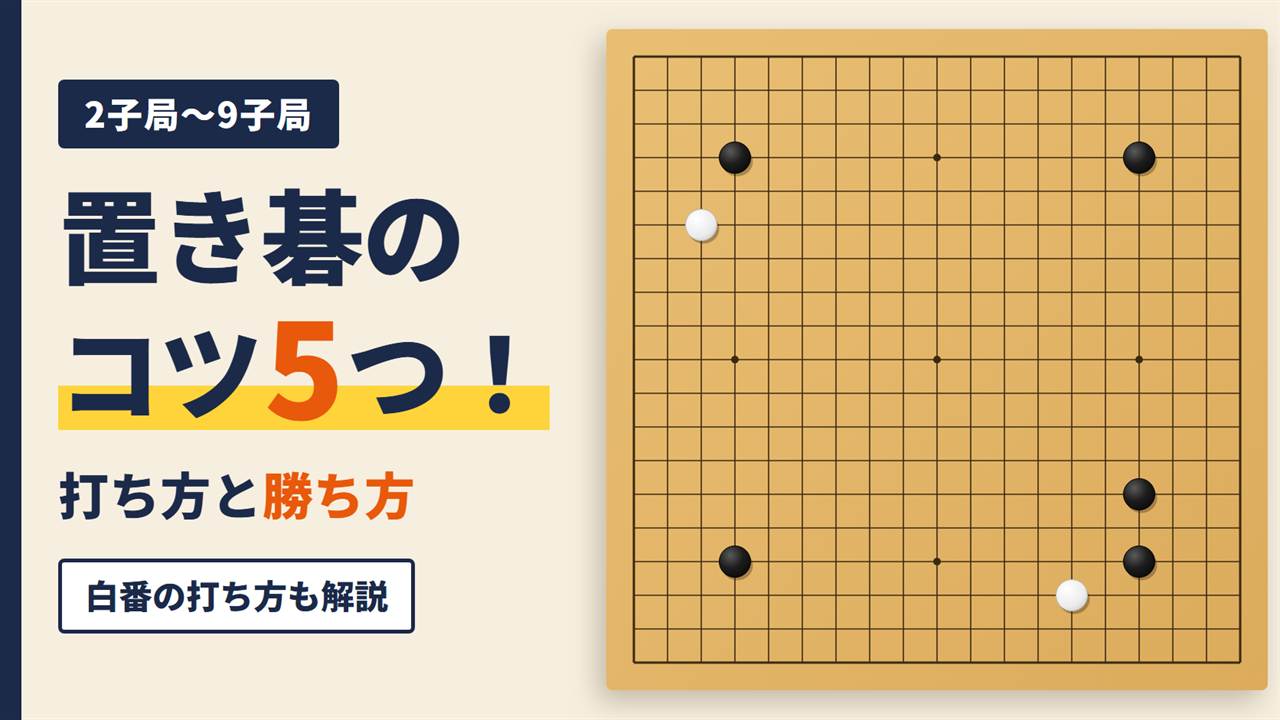
The key for Black to win handicap games is to connect your handicap stones and use them not only to defend, but also to attack White’s weak stones.
In handicap games, several Black stones are placed on the board from the start.
If you make use of that numerical advantage, you can win more easily even without knowing difficult moves.
In this article, we’ll introduce five tips for handicap games, plus how to play from 2-stone to 9-stone games depending on the handicap placement.
Also check how to play as White (the stronger side) and practice methods to build these skills.
[toc]
How to Win Handicap Games: 5 Tips for Black
Here are five tips for Black to win handicap games.
- Play so your handicap stones connect
- Don’t only defend—attack White’s weak stones
- Don’t answer every White move; play first in the biggest area
- Don’t obsess over corner territory—choose outside thickness
- Avoid complicated fights and choose simple, clear shapes
All five are useful ideas no matter how many handicap stones there are.
Play so your handicap stones connect
As Black, play so your stones connect to each other.
Connected stones are harder to capture and function as strong stones on the board.
When White tries to turn the game around, they will try to cut Black’s stones apart and attack isolated groups.
For Black, the scariest development is getting cut and captured.
If you’re unsure what to play, first check whether your stones are safe.
That alone will reduce big losses.
Don’t only defend—attack White’s weak stones
Use the handicap stones not just for defense, but as allies for attack.
In the opening of a handicap game, White’s stones are surrounded mostly by Black stones.
White’s stones are weak the moment they’re played, so Black can take the attacking role.
The important point here is that “attacking” and “capturing” are different.
If you force a capture, you may create weaknesses in your own position.
If you can chase White while increasing your own territory and strong stones, it’s a success for Black even if White escapes.
Attack with a clear purpose in mind.
Don’t answer every White move; play first in the biggest area
You don’t need to respond near White’s move every time.
If you keep answering, the game proceeds exactly as White wants, and your handicap advantage gradually disappears.
Be willing to tenuki and aim for the biggest point on the board.
If you lose because you didn’t answer and got hit by an unexpected attack, that’s fine—use it as study material for future games.
Don’t obsess over corner territory—choose outside thickness
Even if you lose some corner territory, it’s fine as long as you build strong influence on the outside.
A strong wall of stones on the outside is called “thickness.”
Thickness helps you attack enemy stones and build large frameworks.
Handicap stones are placed on star points.
Star points are better for expanding influence toward the sides and center than for tightly enclosing corner territory.
So if White invades the corner, you may lose some points.
But don’t get pessimistic—keep playing while looking at the whole board.
Avoid complicated fights and choose simple, clear shapes
If you’re unsure, choose an easy-to-understand move with fewer complicated variations.
The stronger player wants to drag you into complex fights and wait for mistakes.
The more tangled the position becomes, the more the difference in reading strength shows—and White gains the advantage.
If you’re torn between two candidates, choose the one that connects your stones or removes your own weak group.
However, a solid move is different from a move you don’t need.
You don’t need to keep defending stones that are already strong.
Before playing a defensive move, build the habit of checking once: “Is this stone really in danger?”
Handicap Game Strategy by Handicap: 3 Patterns
How you should play a handicap game changes with the number of handicap stones. It’s easiest to think in these three patterns.
| Handicap stones | Board features | How to play |
|---|---|---|
| 2–3 stones | There are empty corners | Play as if it’s an even game |
| 4–5 stones | All four corners are Black | Defend once, then counterattack |
| 6–9 stones | Black stones are also on the sides | Don’t let your connections be cut |
This is because White’s plans change depending on whether there are open corners and whether there are handicap stones on the sides or center.
Read the section that matches the handicap you’ll play next.
How to play 2-stone and 3-stone games: Play as if it’s even
In 2-stone and 3-stone games, don’t use a special “handicap-only” style—play as if it’s an even game.
An “even game” means a game with no handicap.
In a 2-stone game, two corners remain empty; in a 3-stone game, one corner remains empty.
The board looks close to an even game, and if you become defensive just because you have handicap stones, the small handicap will quickly disappear.
So the key is to keep playing seriously, as if it were even.
How to play 4-stone and 5-stone games: Defend once, then counterattack
The policy for 4-stone and 5-stone games is: “Defend once—then counterattack.”
What you must avoid is answering White every single time.
If you only defend, White will keep taking big points, and your handicap advantage will gradually shrink.
Once you defend and your stones become strong, move forward with the idea of attacking White’s stones next.
When attacking, you don’t need to force a capture.
It’s enough if you can chase White while increasing your own territory and strong stones.
The overall policy doesn’t change much between 4-stone and 5-stone games.
The difference is that in a 5-stone game, Black also has a stone in the center (tengen).
Because stones that come out toward the center can connect more easily to the tengen stone, it’s easier to keep your stones strong in a 5-stone game.
How to play 6–9 stone games: Don’t let your connections be cut
With 6 stones or more, the most important thing is not letting the connections between your handicap stones be cut.
Because Black also has stones on the side star points, there are very few places where White can settle comfortably.
If Black can simply maintain connections, you likely won’t lose badly.
The basic approach is to answer White solidly and defend the points that look like they might be cut.
White can’t catch up by playing normally, so they’ll play unreasonable moves to provoke mistakes.
Keep your connections, chase White’s weak stones, and while chasing, solidify your own territory.
With 6 stones or more, this repetition is the foundation.
How to Play as White in Handicap Games
When you play as White (the stronger side), focus on these three points.
- Use the whole board and aim for complex positions
- Cut Black’s stones apart and create weak groups
- Value sente and keep the initiative
In handicap games, White starts from a disadvantage.
If White plays solidly in the same way as Black, the gap won’t close.
Even if you usually play Black, knowing White’s aims makes it easier to prepare countermeasures.
Use the whole board and aim for complex positions
White should spread stones widely and aim for complex positions where fights can happen.
If White only plays solidly to enclose territory, fights won’t happen.
The game becomes easy for Black to understand, and White won’t be able to catch up in total territory.
Rather than settling for small, solid joseki, taking a broad stance gives White more chances.
Invade even areas where Black has many stones, and create more moments where Black has to think.
This is essentially the reverse of Black’s tip “choose simple, clear shapes.”
Cut Black’s stones apart and create weak groups
Before Black’s stones connect, White should invade to create weak groups and attack them.
If you can cut and capture Black’s stones, you can close the handicap gap at once.
Key targets are the spaces between handicap stones, or moments when Black skips defense.
For White, the basics are to play while constantly looking for “Is there somewhere I can cut?”
Value sente and keep the initiative
For White, it’s important to value sente and keep the initiative.
Sente means playing a move the opponent must answer, so you can then play where you want next.
Since Black starts with more stones, if White plays at the same pace, the gap won’t close.
Don’t finish one area too carefully; don’t “go along” with Black’s moves—rotate first to the next big point.
As a result, White’s stones may become thin.
You also need the resolve to sacrifice small stones even if they get captured.
Two Practice Methods to Build Handicap Skills
You won’t master handicap tips just by reading.
The fastest route is to repeat two things: “play handicap games against AI” and “review after the game.”
Let’s go through them one by one.
Play handicap games against AI
For handicap practice, playing against AI is a great fit.
Handicap games require a stronger opponent, but with AI you can play anytime with any handicap you like.
For example, in PlayGo.gg’s AI games, you can choose from 39 AI levels from 18 kyu to 10 dan and set handicap, komi, and who plays first.
Pick an AI that’s slightly stronger than you, and once you can win, reduce the handicap by one stone.
With this approach, you can measure improvement by the number of handicap stones, making progress easier to feel.
Review after the game to find why you lost
After a handicap loss, check where your handicap advantage disappeared.
A review means looking back over the finished game to find good moves and bad moves.
There are two key things to look for.
- Moments when your stones got cut
- Moments when you answered even though you didn’t need to
Both are situations where you played the opposite of the tips introduced in this article.
If you played against a person, the fastest way is to ask the stronger player right after the game.
If you don’t have someone nearby to teach you, please try PlayGo.gg.
The AI coach points out the moves where you lost points and explains better moves and the reasons in Japanese.
Frequently Asked Questions About Handicap Play
Here are answers to common questions about how to play handicap games.
If I only play handicap games, will I get weaker in even games?
Playing mostly handicap games won’t make you significantly weaker in even games.
That’s because the skills you learn in handicap games—“connecting stones” and “attacking weak stones”—apply directly to even games too.
However, handicap games often involve choosing solid moves.
If you play the same way in even games, your opponent may keep taking the initiative.
If you also play even games alongside handicap games, your style won’t become lopsided.
When should I reduce the handicap?
Once you can beat the same opponent repeatedly, try reducing the handicap.
It goes smoothly if you agree in advance: “If I win in a row, reduce by one stone; if I lose in a row, increase by one stone.”
Each time the handicap drops by one stone, you can confirm your improvement.
Summary
The five tips for Black to win handicap games were:
- Play so your handicap stones connect
- Don’t only defend—attack White’s weak stones
- Don’t answer every White move; play first in the biggest area
- Don’t obsess over corner territory—choose outside thickness
- Avoid complicated fights and choose simple, clear shapes
By handicap, the key points are: in 2-stone and 3-stone games, play as if it’s even; in 4-stone and 5-stone games, defend once then counterattack; in 6–9 stone games, don’t let your connections be cut.
For White, we introduced three points: use the whole board and aim for complex positions, cut the opponent’s stones apart, and value sente to keep the initiative.
Pick one handicap number for your next game and try it in practice.
With PlayGo.gg’s AI games, you can set handicap and play AIs from 18 kyu to 10 dan.
If you lose, review and identify just one cause, then fix it in the next game.